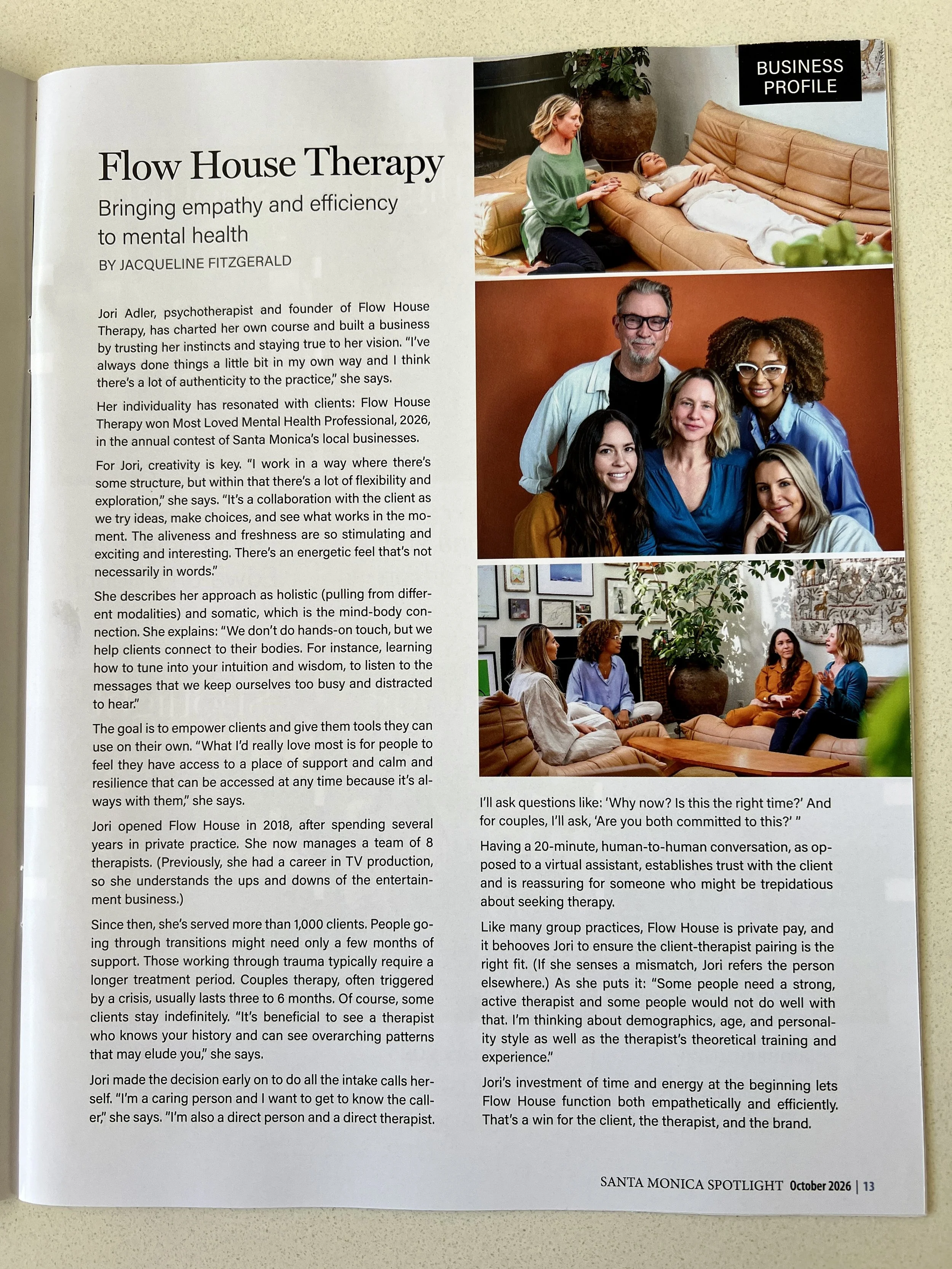
“Santa Monica Spotlight” Profile
Flow House Therapy
Bringing empathy and efficiency to mental health
By Jacqueline Fitzgerald
Jori Adler, psychotherapist and founder of Flow House Therapy, has charted her own course and built a business by trusting her instincts and staying true to her vision. “I’ve always done things a little bit in my own way and I think there’s a lot of authenticity to the practice,” she says.
Her individuality has resonated with clients: Flow House Therapy won Most Loved Mental Health Professional, 2026, in the annual contest of Santa Monica’s local businesses.
For Jori, creativity is key. “I work in a way where there’s some structure, but within that there’s a lot of flexibility and exploration,” she says. “It’s a collaboration with the client as we try ideas, make choices, and see what works in the moment. The aliveness and freshness are so stimulating and exciting and interesting. There’s an energetic feel that’s not necessarily in words.”
She describes her approach as holistic (pulling from different modalities) and somatic, which is the mind-body connection. She explains: “We don’t do hands-on touch, but we help clients connect to their bodies. For instance, learning how to tune into your intuition and wisdom, to listen to the messages that we keep ourselves too busy and distracted to hear.”
The goal is to empower clients and give them tools they can use on their own. “What I’d really love most is for people to feel they have access to a place of support and calm and resilience that can be accessed at any time because it’s always with them,” she says.
Jori opened Flow House in 2018, after spending several years in private practice. She now manages a team of 8 therapists. (Previously, she had a career in TV production, so she understands the ups and downs of the entertainment business.)
Since then, she’s served more than 1,000 clients. People going through transitions might need only a few months of support. Those working through trauma typically require a longer treatment period. Couples therapy, often triggered by a crisis, usually lasts three to 6 months. Of course, some clients stay indefinitely. “It’s beneficial to see a therapist who knows your history and can see overarching patterns that may elude you,” she says.
Jori made the decision early on to do all the intake calls herself. “I’m a caring person and I want to get to know the caller,” she says. “I’m also a direct person and a direct therapist. I’ll ask questions like: ‘Why now? Is this the right time?’ And for couples, I’ll ask, ‘Are you both committed to this?’”
Having a 20-minute, human-to-human conversation, as opposed to a virtual assistant, establishes trust with the client and is reassuring for someone who might be trepidatious about seeking therapy.
Like many group practices, Flow House is private pay, and it behooves Jori to ensure the client-therapist pairing is the right fit. (If she senses a mismatch, Jori refers the person elsewhere.) As she puts it: “Some people need a strong, active therapist and some people would not do well with that. I’m thinking about demographics, age, and personality style as well as the therapist’s theoretical training and experience.”
Jori’s investment of time and energy at the beginning lets Flow House function both empathically and efficiently. That’s a win for the client, the therapist, and the brand.
Santa Monica Spotlight — October 2026